When I decided to create this blog several years ago, Id sis so after I began to think about my own personal plans to deal with Emergency Preparedness. Taking into account the natural disasters I with which I was expecting to have to deal, my goal was based on extremes, to be able to survive without food or water for 72 hours without water or electricity in temperatures as low as 0 Fahrenheit and as high as 120 Fahrenheit, and with winds as high as 25-35 miles per hour. This also included the possibility that I would have to "hike" home 40 miles or sheltering in place at work for an over night.
What I did not take into account was that there might be a global pandemic which would force me to shelter in place/self isolate/quarantine for up to eight weeks. Now I need to take a good hard look at my future planning and make adjustments when things get back to "normal."
My earlier solutions needed to be durable, practical, and exclusively assigned to emergency preparedness so that they would always be ready. Ideally they would be things which I already had on hand, but if not, they would be inexpensive solutions to my preparedness plans. These all remain the same, but now as we are confronted by another "worst" from Mother Nature, I am already making plans for the future as I deal with the present.
I am a bit of an Anglophile, so with that in mind, many of my solutions are based around British surplus military solutions, with items found at low cost from companies like Sportsman's Guide or on eBay and/or recommended on Wilderness Survival or Bushcraft Forums online. Of course I could look at American military surplus, but I did not desire to be confused with American military and other military surplus wouldn't serve my Anglophilic tendencies. This doesn't mean those other options are useful, but I will leave those to others to select and review.
I hope my new additions to my solutions, which I will post about in the coming weeks, will provide helpful information for others as they review their own emergency preparedness plans. And remember, emergency preparedness is not about being reactive to situations, but being proactive. By doing so you reduce your own personal stress by being prepared, as well as reducing the stresses on the entire emergency preparedness system by not drawing upon its resources in an emergency, allowing those who cannot prepare to be served in an emergency.
Saturday, March 21, 2020

Sunday, February 12, 2017
What Do You Do When Your Stored Water Freezes?
As part of my "Get Home Bag" planning, I have included water. My initial thoughts were to place a plastic gallon jug of water in my car, and fill my water bottle from that in case of an emergency.
But I needed to remember that my kit has to be designed to handle sub-freezing temperatures. What happens if that gallon jug of water freezes? How will I thaw it out in an emergency?
My solution was to pack half litre water bottles in my car. The theory being that if they freeze I can thaw them out as needed with my hexamine cooker. Sounded like a good theory, but it needed to be tested. I got that chance this winter when the temperature dropped to 20 degree Fahrenheit.

So I used my knife in my"Get Home Bag" to cut open the bottle of water and I placed it into the water bottle cup, which I placed on my hexamine cooker. It burned for about 7 or 8 minutes and completely thawed out the water, raising its temperature enough to make a mug of hot drinking chocolate. It was not so hot that it burned my mouth, but more like that temperature where you need to drink it while it still retains some heat.
My theory tested with positive results. Its good to know that it not only melted solid bottle of ice, but was able to produce water hot enough to make a mildly hot beverage in 20 degree Fahrenheit weather.
And remember, if you have thoughts and ideas for an emergency situation, test them out in advance to be sure not only the idea works, but the equipment as well.
All Rights Reserved.
But I needed to remember that my kit has to be designed to handle sub-freezing temperatures. What happens if that gallon jug of water freezes? How will I thaw it out in an emergency?
My solution was to pack half litre water bottles in my car. The theory being that if they freeze I can thaw them out as needed with my hexamine cooker. Sounded like a good theory, but it needed to be tested. I got that chance this winter when the temperature dropped to 20 degree Fahrenheit.

So I used my knife in my"Get Home Bag" to cut open the bottle of water and I placed it into the water bottle cup, which I placed on my hexamine cooker. It burned for about 7 or 8 minutes and completely thawed out the water, raising its temperature enough to make a mug of hot drinking chocolate. It was not so hot that it burned my mouth, but more like that temperature where you need to drink it while it still retains some heat.
My theory tested with positive results. Its good to know that it not only melted solid bottle of ice, but was able to produce water hot enough to make a mildly hot beverage in 20 degree Fahrenheit weather.
And remember, if you have thoughts and ideas for an emergency situation, test them out in advance to be sure not only the idea works, but the equipment as well.
All Rights Reserved.
Friday, November 20, 2015
Looking for a Comfortable Tent for Stationary Camping...
I've been looking for a tent for stationary camping. Something that will be large enough for my wife and myself, as well as out dog. Taking a look at the 2-3 man tents, they were quickly ruled out as not being quite large enough. So the task was on to find something a bit larger. I happened upon the British Army 4 Man Arctic Shelter and have decided to give it a try.
I should begin by stating that this tent will be used for stationary camping, that is parking the car and camping just a few feet from it. Because of this, weight of the tent was a minor consideration and comfort and space inside the tent the main factors in its selection.
After looking about a bit, I finally selected the British Army 4 Man Arctic Shelter. Not including the "covered porch on either end of the tent, this tent measures 9'x6' and has 4' of headroom in the center of the tent.

The tent has openings on both ends with the option at one end of the tent to connect two of these tents together end to end.

The entrance can be minimized to two entrances at each end, or opened wide to create an entrance as large as the entire end of the tent.

The shelter is actually two tents, one inner tent consisting of a white cotton roof/sides and a green waterproof floor with short sides/walls. The outer tent is a fly which ties to the inner tent creating an insulating air space between the two tents.

The floor of the tent has a flap, closed by Velcro on three sides which opens to expose the ground below the tent, allowing you to safely operate a camp stove inside the tent.

The tens has mesh ventilation flaps at each end above the door.

And also on the outer tent as part of the "porch."

Along the ridge of the inner tent is a clothes line for drying and airing of clothing

Each end of the tent has a "porch" or covered section of ground for the storage of boots or anything else you want to protect, but don't want to bring inside the tent.
From research, I've been told these can be set up in 5 minutes, but from experience, you should have already tried setting up the tent and also have someone to help you. I have yet to find a published instruction on how to set up the tent, but even without it, I've managed to figure things out.
Also from research, they outer tent has some water repellent issues and should be sheltered from winds. It is not lightweight coming in at about 25 pounds.
But for a tent which you can use in a static camp, provided with a wind break and water proofed for additional water protection, it looks to be a fine tent and I look forward to many years of use.
I bought mine from Keep Shooting and would highly recommend them for their products and exceptional customer service.
All Rights Reserved.
I should begin by stating that this tent will be used for stationary camping, that is parking the car and camping just a few feet from it. Because of this, weight of the tent was a minor consideration and comfort and space inside the tent the main factors in its selection.
After looking about a bit, I finally selected the British Army 4 Man Arctic Shelter. Not including the "covered porch on either end of the tent, this tent measures 9'x6' and has 4' of headroom in the center of the tent.

The tent has openings on both ends with the option at one end of the tent to connect two of these tents together end to end.

The entrance can be minimized to two entrances at each end, or opened wide to create an entrance as large as the entire end of the tent.

The shelter is actually two tents, one inner tent consisting of a white cotton roof/sides and a green waterproof floor with short sides/walls. The outer tent is a fly which ties to the inner tent creating an insulating air space between the two tents.

The floor of the tent has a flap, closed by Velcro on three sides which opens to expose the ground below the tent, allowing you to safely operate a camp stove inside the tent.

The tens has mesh ventilation flaps at each end above the door.

And also on the outer tent as part of the "porch."

Along the ridge of the inner tent is a clothes line for drying and airing of clothing
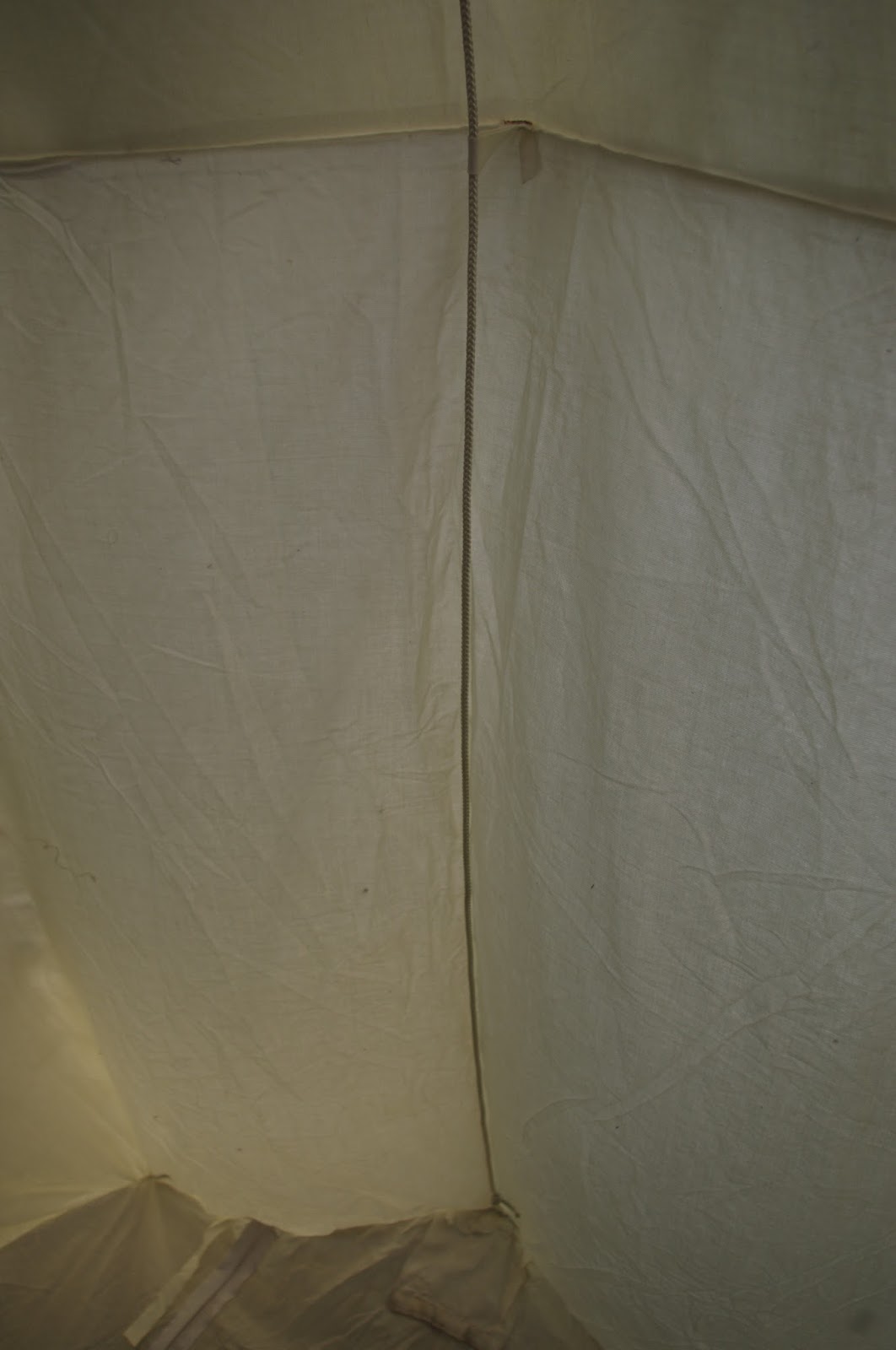
From research, I've been told these can be set up in 5 minutes, but from experience, you should have already tried setting up the tent and also have someone to help you. I have yet to find a published instruction on how to set up the tent, but even without it, I've managed to figure things out.
Also from research, they outer tent has some water repellent issues and should be sheltered from winds. It is not lightweight coming in at about 25 pounds.
But for a tent which you can use in a static camp, provided with a wind break and water proofed for additional water protection, it looks to be a fine tent and I look forward to many years of use.
I bought mine from Keep Shooting and would highly recommend them for their products and exceptional customer service.
All Rights Reserved.
Saturday, November 14, 2015
A Solid Fuel Solution to Emergency Cooking...
Hexamine, formally known as Hexamethylene Tetramine, is a solid fuel used for cooking in the British Army which was invented in Germany in 1936. Commonly known as a Tommy Cooker, it can be found commercially under the brand name Esbit, though the British Army version is larger. (I've found commercial versions of the British cooker available from Mil-Com and Kombat)


The British Army cooker is pocket sized (4 3/4" x 3 3/4"x 1 1/8" closed or 4 3/4" x 3 3/4" x 2 5/8" open), and comes issued in a brown paper wrapper with an adapter to hold a Crusader mug securely for heating. The tablets, 8 in the British Army issue, come packed in a waxed box packed inside the metal cooker. The standard issue is one cooker every three days and a refill of the fuel tablets every day.

Tablet burns about 7 1/2 minutes and was true for both tests. Leaves a residue on the mug or mess tin which can be cleaned off with a Brillo pad or in a pinch with a used tea bag. Doesn't quite reach at boil at 60 degrees, but is definitely hot enough to brew a mug of tea. (during the tests I brewed 500ml of water for tea.) The same was true at 70 degrees. During the 70 degree test, the water was too hot to keep a finger in it beyond 1 second by 4 1/2 minutes heating time. As the fuel is waxy, it is not easy to ignite, requiring three hurricane matches to light one tablet.

In the second test I used a single wooden match and achieved the same results.

In my third test I went back to the hurricane matches and again required three. This time I heated up a mushroom omelet boil in the bag from a 24 hour ration. This fit snugly in the crusader mug with about half a litre of water. This heated nicely from the full 7 1/2 minute burn and I used the remaining heated water to make a cup of instant coffee. Using only 300ml of water the stove was able to bring the water to a rolling boil.

The fuel is toxic to consume and it is said the smell of the burning fuel is dreadful, though I did not experience this while cooking outdoors.

I would be sure to use the stove on a non-flammable surface, as well and a surface you are not worried about having damaged. The hexamine or its wax coating seems to drip down from the stove occasionally so you should be aware before you set it up for use.
This is my new go to emergency stove so you can certainly say that I'm hooked on hexi!
For those looking for British Army Hexamine, I suggest Go Army in Glasgow.
All Rights Reserved.


Tablet burns about 7 1/2 minutes and was true for both tests. Leaves a residue on the mug or mess tin which can be cleaned off with a Brillo pad or in a pinch with a used tea bag. Doesn't quite reach at boil at 60 degrees, but is definitely hot enough to brew a mug of tea. (during the tests I brewed 500ml of water for tea.) The same was true at 70 degrees. During the 70 degree test, the water was too hot to keep a finger in it beyond 1 second by 4 1/2 minutes heating time. As the fuel is waxy, it is not easy to ignite, requiring three hurricane matches to light one tablet.

In the second test I used a single wooden match and achieved the same results.

In my third test I went back to the hurricane matches and again required three. This time I heated up a mushroom omelet boil in the bag from a 24 hour ration. This fit snugly in the crusader mug with about half a litre of water. This heated nicely from the full 7 1/2 minute burn and I used the remaining heated water to make a cup of instant coffee. Using only 300ml of water the stove was able to bring the water to a rolling boil.

The fuel is toxic to consume and it is said the smell of the burning fuel is dreadful, though I did not experience this while cooking outdoors.

I would be sure to use the stove on a non-flammable surface, as well and a surface you are not worried about having damaged. The hexamine or its wax coating seems to drip down from the stove occasionally so you should be aware before you set it up for use.
This is my new go to emergency stove so you can certainly say that I'm hooked on hexi!
For those looking for British Army Hexamine, I suggest Go Army in Glasgow.
All Rights Reserved.
Wednesday, November 11, 2015
The Perfect Little Multi-Tool...
It might sound silly to some, but until this year, I've never owned a multi-tool. Until now I've always relied on a pocket knife. In making emergency preparedness plans and even looking at camping / bushcrafting, I realized I needed to find a quality multi-tool. After some research, I've selected the Gerber Crucial, which was issued to the British Army in Afghanistan.

Like my previous blog on the Gerber Onyx 50 flashlight, Gerber was unable to provide me with information as to when this multi-tool was introduced, but the good news is that this multi-tool is still available.
One of the guiding features I needed was a knife blade under 2 1/2 inches, which is the requirement for entrance into US Federal Government Buildings.
Open the multi-tool has an overall length of 5.5" and closed it is a mere 3.6", weighing only 5 ounces. In addition to the knife, it features pliers with v-cut wire cutters, as well as a philips head and standard screw driver. It also features a belt clip and carabiner to secure to your clothing or gear. Mine also came with a durable nylon knife case with can fit to your belt or even Molle gear.
I wish I could say more about this or give more specifics, but Gerber or their website was unable to provide more information. Luckily this multi-tool speaks for itself. I love mine and would recommend it to others. Mine is in gray, but they also sell them in black, green, blue.
All Rights Reserved.

Like my previous blog on the Gerber Onyx 50 flashlight, Gerber was unable to provide me with information as to when this multi-tool was introduced, but the good news is that this multi-tool is still available.
One of the guiding features I needed was a knife blade under 2 1/2 inches, which is the requirement for entrance into US Federal Government Buildings.
Open the multi-tool has an overall length of 5.5" and closed it is a mere 3.6", weighing only 5 ounces. In addition to the knife, it features pliers with v-cut wire cutters, as well as a philips head and standard screw driver. It also features a belt clip and carabiner to secure to your clothing or gear. Mine also came with a durable nylon knife case with can fit to your belt or even Molle gear.
I wish I could say more about this or give more specifics, but Gerber or their website was unable to provide more information. Luckily this multi-tool speaks for itself. I love mine and would recommend it to others. Mine is in gray, but they also sell them in black, green, blue.
All Rights Reserved.
Thursday, November 5, 2015
When You Need To Light Up The Night...
I've been looking for a compact flashlight to use outdoors and was overwhelmed at the choices. After some research,I've selected the Gerber Onyx 50 Flashlight which was issued to the British Army in Afghanistan. If it was rugged enough for them, I think I can trust it to be rugged enough for me.

I'd love to tell you when it was introduced and when it was discontinued (yes, unfortunately it was discontinued) but Gerber was unable to provide me with that information. I'd also like to be able to tell you the "official" specifications as provided by Gerber, but they did not answer my requests for that information, so I've had to improvise and see what I could find from non-official online sources.
The Onyx 50 features an anodized aluminum body and tail cap switch, providing between 20 and 30 lumen of brightness. It is powered by a single AA battery with a battery life of 4 1/2 hours. It provides a steady white light projecting 25 meters, with no options for brightness control or flashing. It is approximately 4 3/4" long and 1" wide and weight 2.3 ounces without battery. The flashlight is water resistant, but I have found no information regarding how water resistant it was designed.
The Onyx 50 feels good in the hand and comes with a short lanyard. It is quite rugged and despite the lack of response from Gerber for information, I would recommend this flashlight, even though it has been discontinued. Gerber offers no flashlight as a replacement for this discontinued product which is a shame for anyone looking to find something similar.
All Rights Reserved.

I'd love to tell you when it was introduced and when it was discontinued (yes, unfortunately it was discontinued) but Gerber was unable to provide me with that information. I'd also like to be able to tell you the "official" specifications as provided by Gerber, but they did not answer my requests for that information, so I've had to improvise and see what I could find from non-official online sources.
The Onyx 50 features an anodized aluminum body and tail cap switch, providing between 20 and 30 lumen of brightness. It is powered by a single AA battery with a battery life of 4 1/2 hours. It provides a steady white light projecting 25 meters, with no options for brightness control or flashing. It is approximately 4 3/4" long and 1" wide and weight 2.3 ounces without battery. The flashlight is water resistant, but I have found no information regarding how water resistant it was designed.
All Rights Reserved.
Looking for a Light When You Need Both Hands Free...
I'm going to admit that I'd never really given a headlamp much consideration until I started watching bushcrafter videos and seeing how much easier it is to do things in the dark with both hands free using a headlamp versus trying to hold a flashlight while performing tasked which usually require both hands. They're just were not something I used as a boy when camping, so I was not naturally drawn to them. That's all changed now.

The headlamp I selected was the Silva Ranger headlamp, which was issued to the British Army in Afghanistan. Being selected for such rugged use, I felt fairly safe in selecting this commercially available headlamp for my own purposes. It was designed with durability as it's main feature and even has a red light mode to protect your night vision. It is fully waterproof to IPX7 (submersible to one meter for 30 min) and features the Silva Intelligent Light® technology comprising both a strong light for distance, and the floodlight necessary for close-up vision. This headlamp began production at Silva Shenzhen, China in 2009 and was discontinued in 2015.
Specification for the Silva Ranger Headlamp:

The headlamp I selected was the Silva Ranger headlamp, which was issued to the British Army in Afghanistan. Being selected for such rugged use, I felt fairly safe in selecting this commercially available headlamp for my own purposes. It was designed with durability as it's main feature and even has a red light mode to protect your night vision. It is fully waterproof to IPX7 (submersible to one meter for 30 min) and features the Silva Intelligent Light® technology comprising both a strong light for distance, and the floodlight necessary for close-up vision. This headlamp began production at Silva Shenzhen, China in 2009 and was discontinued in 2015.
Specification for the Silva Ranger Headlamp:
Batteries/type - 1x AA
Beam pattern - Intelligent Light® optimized light distribution
Bulb type - 4x White LED + 1x Red LED
Discharge time (max mode) - 3h
Discharge time (min mode) - 20h
Light distance - 29m
Light modes - Max, Med, Min, Blink, Red, Red Blink
Light output - 30 Lumen
Water resistance - IPX7 Waterproof (submersible to one meter for 30 min)
Weight - 75g
The Silva Ranger Headlamp has now been replaced by the Silva Explore Headlamp which uses the same AA battery and Intelligent Light® optimized light distribution pattern and has the same level of water resistance. The Explore has added a battery status indicator which functions when the headlamp is turned off. They have changed from 4x White LED + 1x Red LED in the Ranger to 1x High power LED in the Explore. The discharge time in the max mode remains the same for both headlamps, but the discharge time in the min mode is only 10 hours in the Explore versus 20 hours in the Ranger. The light distance in the Explore has increased over the Ranger from 29 meters to 40 meters with the light output increasing from 30 lumen to 60 lumen, and the weight of the headlamp has decreased from 75 grams to 47 grams. The light modes have changes from Max, Med, Min, Blink, Red, Red Blink in the Ranger to Max, Min, Blink, Red, Orange in the Explore.
I haven't tested the Silva Explore, but I will have to give Silva top marks for their Ranger headlamp and would highly recommend the brand for anyone looking for a headlamp when rugged reliability is a priority.
All Rights Reserved.
The Silva Ranger Headlamp has now been replaced by the Silva Explore Headlamp which uses the same AA battery and Intelligent Light® optimized light distribution pattern and has the same level of water resistance. The Explore has added a battery status indicator which functions when the headlamp is turned off. They have changed from 4x White LED + 1x Red LED in the Ranger to 1x High power LED in the Explore. The discharge time in the max mode remains the same for both headlamps, but the discharge time in the min mode is only 10 hours in the Explore versus 20 hours in the Ranger. The light distance in the Explore has increased over the Ranger from 29 meters to 40 meters with the light output increasing from 30 lumen to 60 lumen, and the weight of the headlamp has decreased from 75 grams to 47 grams. The light modes have changes from Max, Med, Min, Blink, Red, Red Blink in the Ranger to Max, Min, Blink, Red, Orange in the Explore.
I haven't tested the Silva Explore, but I will have to give Silva top marks for their Ranger headlamp and would highly recommend the brand for anyone looking for a headlamp when rugged reliability is a priority.
All Rights Reserved.
Subscribe to:
Posts (Atom)